
Campaigns
Building the Road to a Neuroinclusive Future
Campaigns
At the Neurodiversity Foundation, our campaigns are not side projects around the edges of our work. They are how we turn mission into movement, and movement into daily reality.
We do not only speak about a better future for neurodivergent people. We build the conditions that help that future arrive.
We turn ideals into tools, traditions and pathways people can actually use: celebrations, classrooms, community spaces, research, policy proposals, grants, technologies, and rituals that make dignity more real in everyday life.
Across our four departments — Pride, Education, Research, and Advocacy & Awareness — our campaigns connect projects, products, events, frameworks, services, communities and long-term stewardship. Some are cultural. Some are educational. Some are technological. Some are political. All of them are part of the same larger promise: to help build a world where every brain can belong, contribute, and thrive as itself.

swipe
Pride
Culture, Belonging and Self-Acceptance
Our Pride work focuses on the shift from performance to authenticity.
For many neurodivergent people, the first lesson society teaches is that belonging must be earned by hiding. Masking becomes a survival strategy. Difference becomes something to explain, soften or apologise for. And too often, people learn to survive by becoming less visible.
The Pride department exists to change that. It builds cultural rituals, public celebrations, friendship pathways and community spaces where neurodivergent people can see themselves differently: not as problems to be fixed, but as whole people with dignity, beauty, insight, rhythm, humour, intensity, sensitivity, creativity and strength.
Campaign for Neurodivergent Self-Acceptance
Self-acceptance should never be a lonely task carried in silence. Too many neurodivergent people grow up surrounded by deficit-based language and the pressure to earn belonging through performance. This campaign exists to dismantle the burden of masking and replace it with something stronger: the courage to take up space as yourself.
Through this campaign, we build the cultural traditions that make pride something people can practise together. Neurodiversity Pride Day on June 16, ND Pride Week, the Science Conference, the flag-hoisting ritual, ND Pride flags, Pride Frames and school lessons about ND Pride all help create public recognition. The VR Pride Universe, the DJ Marathon, Neurospicy Workshops, the narrative work of #weareallnuts, the Stride App and the sports programme bring pride into movement, creativity, learning, embodiment and community.
This campaign is not only about visibility. It is about memory, language and ritual. It gives neurodivergent people moments in the year where they do not have to explain why they matter. They can gather, celebrate, reflect, dance, learn, speak, raise a flag, join an event, enter a virtual world, or simply recognise: my brain belongs in the human story.
Already taking shape: Neurodiversity Pride Day has grown from a Dutch initiative into an international celebration, with flag-hoistings, online and offline events, global participation, and a growing set of traditions that make neurodivergent pride visible across countries and communities.
The Point on the Horizon: A future where every neurodivergent child grows up seeing their brain-type not as a defect to be hidden, but as an essential part of our collective human brilliance.
Self-Acceptance & Pride is the symbolic heart of the Foundation’s pride work. It helps neurodivergent people move from shame, masking, and isolation toward self-acceptance, visibility, joy, and dignity.
Key pathways
Neurodiversity Pride Day, ND Pride Week, rituals, media, and messages that celebrate neurodivergent identity.
Friendship & Belonging focuses on connection, community, and accessible ways for neurodivergent people to meet. It recognises that belonging is a basic human need.
Key pathways
Community-building projects, meetups, social spaces, and friendship-oriented work that counters loneliness and exclusion.
Campaign for Neurodivergent Friendship
Belonging is not a luxury. Friendship is not a bonus feature of life. For many neurodivergent people, loneliness is not caused by a lack of interest in others, but by social worlds built around timing, small talk, sensory expectations, hidden rules and forms of performance that can make connection exhausting.
This campaign grows from a simple truth: neurodivergent people deserve friendship, fun and community without having to pass a neurotypical social test first. We are not trying to teach people how to fit into the wrong room better. We are helping build rooms where real connection has a chance to happen.
In our architecture, this work includes the Together ecosystem: the Together App, the Together Webapp and ietsdoen.nu as digital doorways into interest-led social life. It also includes physical and community formats such as the Neurocafé Network, Neurodance, Neurodive, Friends Fire and Makefriendsandfire. These formats make social life more manageable, more authentic and more welcoming on neurodivergent terms.
This campaign understands friendship as something that can be designed for. Not forced, not scripted, not reduced to “social skills”, but made more possible through low-pressure invitations, repeatable spaces, interest-based connection and environments where people can arrive as they are.
Already taking shape: Together, Neurocafé, Neurodance and Neurodive show how digital tools and community formats can lower the threshold for meeting, returning, joining, dancing, talking, or simply being around others without masks, expectations or pressure.
The Point on the Horizon: A world where neurodivergent social belonging is seamless, supported by a dense global network of peer-led community homes.
Education
Learning, Work and Everyday Access
Our Education work focuses on the places where people are shaped, supported and given the tools to understand themselves.
Education is not only what happens in school. It also happens in workplaces, coaching rooms, online courses, newsletters, toolkits, museums, communities, training sessions and moments of self-recognition. The Education department helps translate neurodiversity into everyday practice: how we teach, how we work, how we support, how we explain, and how we make knowledge accessible.
This department works from a simple belief: support should not only begin after harm has already happened. We need schools, workplaces and learning systems that recognise strengths earlier, reduce needless exclusion, and make affirming knowledge easier to reach.
1. Campaign for Neuro-inclusive Classrooms
A classroom shapes much more than academic attainment. It shapes self-image. When schools read difference mainly through deficits, many students learn that they are the problem. They become the child who is “too much”, “too slow”, “too sensitive”, “too distracted” or “too complicated”.
We are not interested in classrooms that merely “include” neurodivergent students in theory while exhausting them in practice. This campaign aims to move schools away from deficit-thinking toward environments where more students can genuinely thrive.
Our clearest flagship is the Neurodiversity-Friendly Schools Program, supported by the wider work of the Neurodiversity Education Academy, international partnerships and European partnership projects. We provide a practical ecosystem of tools including My Amazing Brain magazine, My Creative Brain, Brainy App, What’s STRONG With You? toolkits, teen empowerment journals, Brain Strength Card Decks, school workshops and the Educator Courses App.
This work helps teachers look beyond behaviour management toward regulation, participation, strengths, self-understanding and belonging. It is enhanced by projects such as EFURM, which explores museum-based inclusion strategies, NeuroEmergence, which creates space for learning labs and community practice, and the Sigma Project’s AI-VR simulations for educators.
The goal is not to make every child fit the same classroom. The goal is to help classrooms become places where more kinds of minds can learn without being shamed for the way they process, move, focus, communicate or recover.
Already taking shape: This campaign has already produced magazines, classroom-ready tools, app components, workshops, strengths-based resources and programme structures that schools, teachers and students can actually use.
The Point on the Horizon: A global educational standard where every learning environment notices strengths and reduces needless exclusion from the start.
Neuroinclusive Classrooms supports schools and educators in creating learning environments where neurodivergent students are understood and respected.
Key pathways
Strengths-based practice, sensory awareness, flexibility, belonging, and reducing exclusion.
Thriving at Work supports workplaces where neurodivergent people can succeed without constant masking or burnout.
Key pathways
Tools, coaching, training, keynotes, and practical advice for teams and organisations.
2. Campaign for Thriving in the Workplace
Economic inclusion is one of the clearest tests of whether a society truly believes neurodivergent people belong. A workplace is not inclusive if people can only survive there by masking, over-adapting or burning out.
Too many workplaces still reward one narrow model of communication, pacing, sensory tolerance and performance. A “good employee” is often imagined as someone who fits the system without asking the system to change. This campaign exists to reverse that logic.
Through our Workplace Thriving project, we provide the practical tools and professional support needed to redefine productivity, collaboration and performance through a neurodiversity-affirming lens. This includes the Neuroprofiler tool, the Thriving at Work book, Beyond Burnout, professional keynotes, trainings, webinars, corporate coaching, group coaching, in-company coaching, consultancy services and policy review.
The campaign also connects to the wider ecosystem of workplace change, including ND Alliance & Advisory in workplaces and Neurodiversity in Business Netherlands. The goal is not a cosmetic diversity story. It is stronger conditions for participation, where different ways of thinking are treated as operational assets rather than workplace complications.
This campaign helps organisations ask better questions. Not: “How do we make neurodivergent employees behave more normally?” But: “What would work look like if more forms of attention, communication, energy, recovery and problem-solving were taken seriously?”
Already taking shape: Our workplace work already connects coaching, training, policy, tools, public speaking, organisational advice and ecosystem-building, helping workplaces move from awareness toward practical neuroinclusion.
The Point on the Horizon: A labour market where neurodivergent talent is actively sought after as a prerequisite for innovation in every sector of the economy.
3. Campaign for Free Access to ND Materials
If useful knowledge or affirming materials are available only to those with time, money, diagnosis, professional access or institutional permission, then inclusion remains shallow.
A movement that believes in dignity cannot reserve self-understanding and support for people who can easily pay for them. Financial barriers, long waiting times and bureaucratic thresholds often hit hardest at the exact moments when people most need language, tools and care.
This campaign ensures that socio-economic barriers do not block people from accessing the resources they need to flourish. Through the NEA Newsletter, we distribute a growing library of resources, including magazines like My Creative Brain and toolkits like What’s ALIVE in You?. The broader Academy ecosystem includes free resources, low-cost toolkits, downloadable guides, reflection tools, card decks, practical supports and learning materials that people can use in real life.
We explicitly remove gatekeepers through the Mikel Rijsdijk Memorial Grant, providing coaching access and courses to people in need. The Limbo Project supports neurodivergent queer refugees during some of the most vulnerable transitions a person can face. Related support pathways, including coaching and community-based access routes, help make neuroinclusive knowledge less dependent on income or formal status.
This campaign is about distribution as dignity. It asks: who gets access to support, and who is quietly left out? Then it builds pathways that bring more people inside.
Already taking shape: The Mikel Rijsdijk Memorial Grant, the Limbo Project, NEA resources, free PDFs, low-cost guides, newsletters, coaching routes and accessible materials show how support can become less dependent on money, permission or formal systems.
The Point on the Horizon: An equitable world where high-level self-understanding tools and professional guidance are freely available to everyone, regardless of background or income.
Free Access ensures that knowledge, tools, and support are not only available to people who can afford them.
Key pathways
Educational materials, resources, courses, worksheets, and practical tools shared widely.
Research
Knowledge, Communication and Innovation
Our Research work focuses on the places where knowledge becomes tools, where lived experience becomes design, and where neurodivergent people help shape the questions being asked.
For too long, neurodivergent lives have often been studied from a distance, interpreted through narrow frames, or translated into systems that were not built with neurodivergent people in the room. We want a different knowledge culture: one that is ethical, practical, participatory and useful.
The Research department connects student-led research, fellows, consortia, publications, communication tools, assistive technology, innovation pathways and public knowledge-sharing. It is where curiosity becomes responsibility.
1. Campaign for Advancing Research & Knowledge Sharing.
Knowledge shapes policy, education, work, care and public imagination. When neurodivergent lives are studied mainly through narrow medical or deficit-first lenses, the result can be elegant theory and poor social reality.
This campaign exists to build a different knowledge culture: one that takes lived experience seriously, values practical usefulness, and shares knowledge in ways that can actually change systems.
Through the Research Fellows Program, student-led research, the Neurovisionary and ND Builders consortia, participation in wider research networks, research reports, formal publications and the annual Science Conference, we help neurodivergent people participate as fellows, co-designers, researchers and knowledge-makers.
We translate these insights into public and usable knowledge through the Neurodignity Canon, the Neurodiversity Deepdive Podcast, reports, publications and community-facing learning formats. Research only becomes movement-building knowledge when it travels back into classrooms, policy, workplaces, families and daily life.
This campaign is not only about producing more information. It is about changing who gets to know, who gets to ask, who gets to interpret, and who benefits from the answers.
Already taking shape: The Research Fellows Program, student-led research pathways, mentoring, reports, publications, the Science Conference, the Neurodignity Canon and the Neurodiversity Deepdive Podcast are building research capacity as well as research output.
The Point on the Horizon: A scientific community where neurodivergent experts are primary authors of the knowledge that affects their own lives.
Research & Knowledge builds neurodiversity knowledge through fellows, publications, conferences, and podcasts grounded in lived experience.
Key pathways
Fellows program, publications, Science Conference, and research reports.
Assistive Communication supports tools and sign-based systems that respect agency, autonomy, and real-life family needs.
Key pathways
Personal sign language, assistive technology, and communication access research.
2. Campaign for Assistive Communication
This campaign begins with an ethical promise: everybody deserves to be understood in a way that protects their dignity.
Communication should never be treated as a narrow test of normality. When fluent speech, fast response, typical eye contact or dominant communication styles become the standard, many neurodivergent people are taxed simply for trying to be understood. This can restrict autonomy, strain families, limit participation and make everyday life less safe.
Led by the ATHENS Initiative, this campaign develops communication tools and sign-based systems that support agency, family life and different ways of being understood. We are co-creating SIGNS Messenger and a Signs language model, curating sign-based communication pathways tailored to neurodivergent individuals and their families.
This work also points beyond a single tool. It connects to Family Signs, AI-supported communication pathways and prototypes such as Mini the Robot, which explore how technology can support communicative agency and social participation.
The heart of the campaign is simple: communication access is not an optional extra. It is part of dignity. When more forms of expression become possible, autonomy becomes stronger and participation becomes more real.
Already taking shape: ATHENS, SIGNS Messenger, Family Signs, sign-language curation, AI-supported communication pathways and early prototypes show how assistive communication can move from principle into practical tools.
The Point on the Horizon: A world where communicative autonomy is treated as a human right and supported by intuitive, accessible technology.
3. Campaign for Advancing Opportunities for Innovation
Many neurodivergent people are already solving problems the world has not even named properly yet. The task is not to suppress that inventive energy, but to recognise it, support it and help it travel.
Neurodivergent people are often asked to adapt to systems they did not design. Yet many of the most practical ideas for better systems begin with the lived ingenuity of people who notice friction, mismatch or inefficiency first-hand.
The public face of this work is Autvinder, where autistic inventors are recognised through the Autvinder Competition and the Autvinder Awards. This is supported by ND Hacks, our digital incubator and platform for creators, and by the Design Your Life consortium, which helps place neurodivergent individuals at the heart of designing the future.
The campaign also includes ND Innovators, workshops for innovators, support for inventors, community recognition and practical next steps for people with ideas that deserve structure, visibility and momentum.
This campaign values invention not as abstract creativity, but as a pathway from lived problem-solving to prototyping, recognition, community backing and social usefulness.
Already taking shape: Autvinder, the Autvinder Competition, Autvinder Awards, ND Hacks, ND Innovators, Design Your Life, workshops and inventor-support pathways together create both recognition and next-step infrastructure for neurodivergent innovation.
The Point on the Horizon: A society that actively invites neurodivergent thinkers to help solve the most complex technical and social problems of the next century.
Innovation supports neurodivergent inventors and app builders as creators of solutions.
Key pathways
Hackathons, innovation projects, inventor recognition, prototypes, and future-facing experiments.
Advocacy & Awareness
Rights, Policy and Protection
Our Advocacy & Awareness work focuses on the places where dignity must become public pressure, legal argument, political voice and structural protection.
Awareness matters, but awareness alone is not enough. People can praise neurodiversity in principle while leaving harmful systems untouched. They can celebrate difference in a campaign while maintaining policies that exclude, pathologise or punish it in practice.
This department works where recognition must become responsibility: in politics, law, public policy, municipal practice, anti-harm work and democratic representation.
1. Campaign for Political Participation.
We insist that neurodivergent people should not only appear in policy as a target group, but as a political voice.
Public policy shapes diagnosis, education, work, care, transport, public space and the basic conditions of citizenship. Yet neurodivergent people are still too often spoken about rather than spoken with. This campaign exists to change that power imbalance.
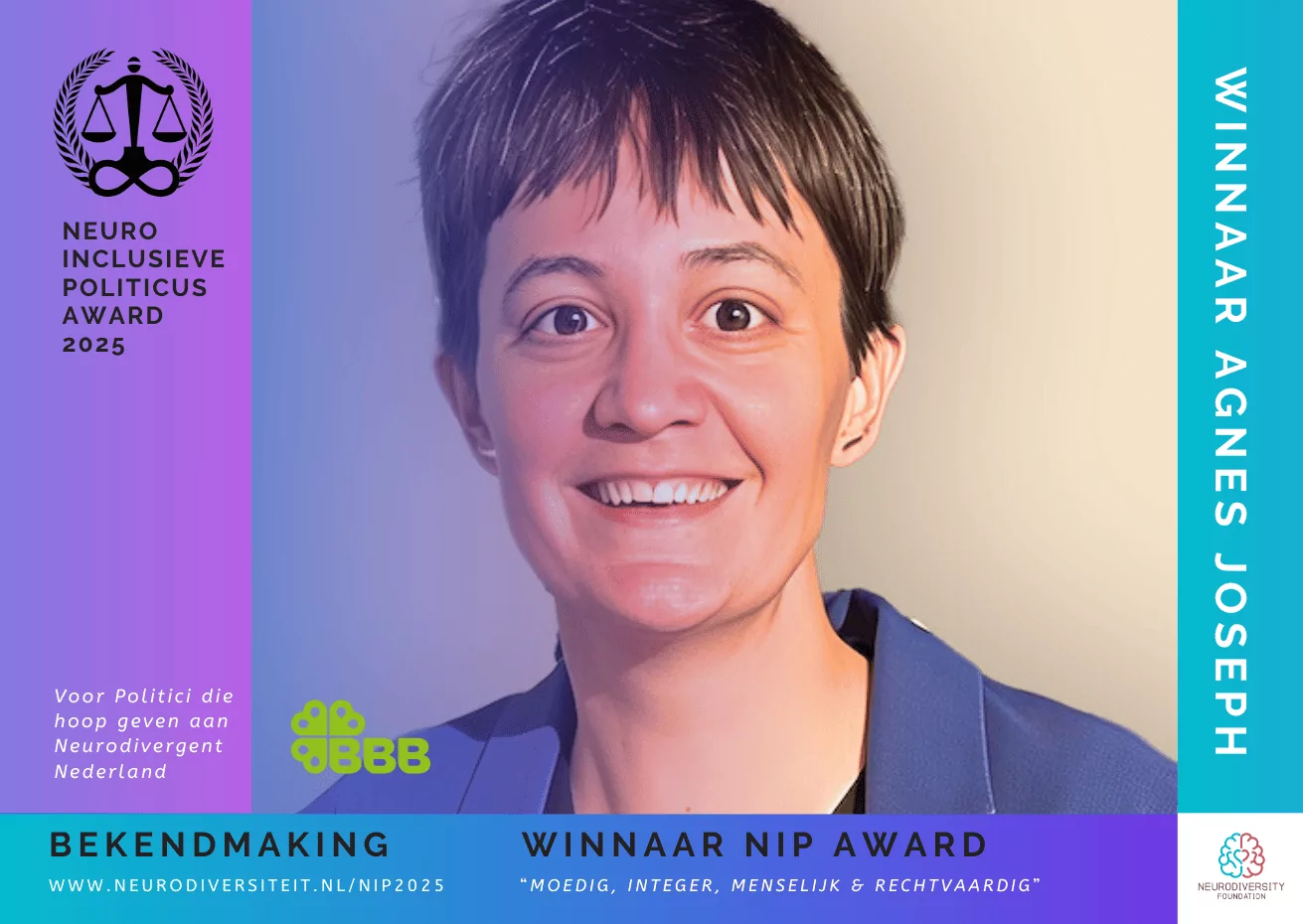
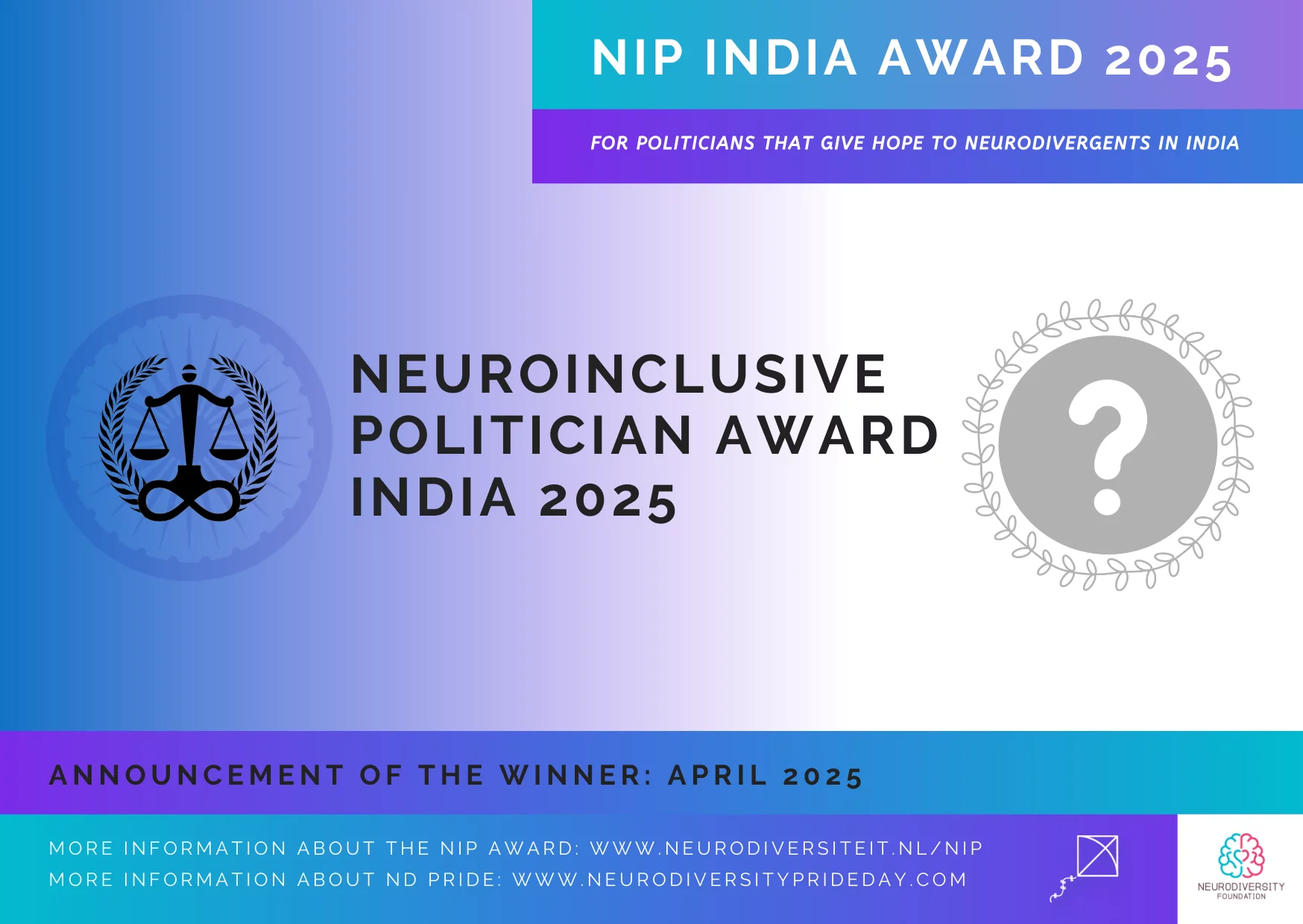
Through the Neuro-Inclusive Politician Award, we translate lived experience into public accountability and political recognition in both the Netherlands and India. Through the Neuroinclusive City Scorecard and the annual City of the Year recognition, the campaign reaches into local government and helps municipalities assess, compare and improve neuroinclusive policy.
By sharing the 10 Motions for a Neurodivergent Netherlands, we provide a concrete policy package that covers areas such as teacher education, anti-harm priorities and the elimination of discriminatory driving tests. Through Political Influence: Non-Zero methods, lobbying, policy proposals and Neurodiversity Scorecards, we make party positions visible and move political imagination from national parliaments into daily municipal practice.
This campaign is broader than electoral visibility alone. It builds democratic pathways, accountability mechanisms and public hope.
Already taking shape: The Neuro-Inclusive Politician Award, neuroinclusive city work, the 10 Motions, scorecards, policy proposals and political advocacy show that this campaign is building a public record of neuroinclusive leadership and institutional change.
The Point on the Horizon: Full political representation where neurodiversity is a standard, mainstream consideration in every legislative debate worldwide.
Political Participation strengthens neurodivergent voice in public decision-making. It includes work that helps decision-makers understand neurodiversity through dignity and lived experience.
Key pathways
Awards, policy proposals, civic influence, and Neuroinclusive Cities & Public Space initiatives.
Legal Advocacy protects neurodivergent people from harmful practices and discriminatory systems that undermine autonomy.
Key pathways
Healthcare and education reform, structural harm reduction, and Intersectional Solidarity initiatives.
2. Campaign for Legal Advocacy
This campaign is the protective shield of our ecosystem: the place where dignity becomes legal pressure and structural resistance to harm.
There is a difference between awareness and protection. People can praise neurodiversity in principle while leaving harmful laws, gatekeeping, discrimination or coercive practice untouched. This campaign exists because neurodignity needs a shield.
Our legal advocacy work serves to protect the physical and emotional integrity of neurodivergent citizens from systems that undermine autonomy. This includes our firm stand in the Anti-ABA Campaign, our Drivers Licence Discrimination Lobby, the 7th Pillar EU proposal, the Neurodignity Framework, and our quieter Under the Radar support for decision-makers.
The campaign works both in public argument and in strategic policy influence. Sometimes dignity needs a public campaign. Sometimes it needs a policy memo. Sometimes it needs a meeting, a framework, a legal argument, a coalition, or a refusal to accept harm as normal.
Whether through the long-horizon proposal to recognise neurodiversity as a pillar of European diversity policy, or through concrete action against discriminatory barriers, this campaign exists because safety and integrity should never depend on luck.
Already taking shape: Anti-ABA advocacy, drivers-licence discrimination work, the 7th Pillar proposal, Under the Radar support and the Neurodignity Framework show how rights work can become morally clear, evidence-backed and structurally focused.
The Point on the Horizon: A legal framework where neurodignity is protected and neurodiversity is recognised as a permanent pillar of inclusion policy.
Leadership
Growth & Stewardship
Growth, for us, is not growth for growth’s sake. It is the discipline of becoming more capable without becoming more careless.
The larger the Foundation becomes, the more it needs structures that protect care, coherence, ethics and continuity. This campaign exists because scale is not the goal on its own. Responsible, values-held scale is.
This campaign centres on the professionalisation of our organisation, guided by the strategic wisdom of the Wisdom Council and the governance of the Executive Board. It includes advisory guides, strategic frameworks, board development, international coordination, leadership structures and long-term organisational learning.
Its purpose is to help the Foundation grow its benevolent impact while protecting the integrity of its core mission: bridging the gap between neurodivergent people and a society not yet fully prepared for them.
We want a larger future, but one that still knows how to listen. We want a stronger organisation, but not one that forgets tenderness. We want to scale the work without scaling harm, exhaustion or mission drift.
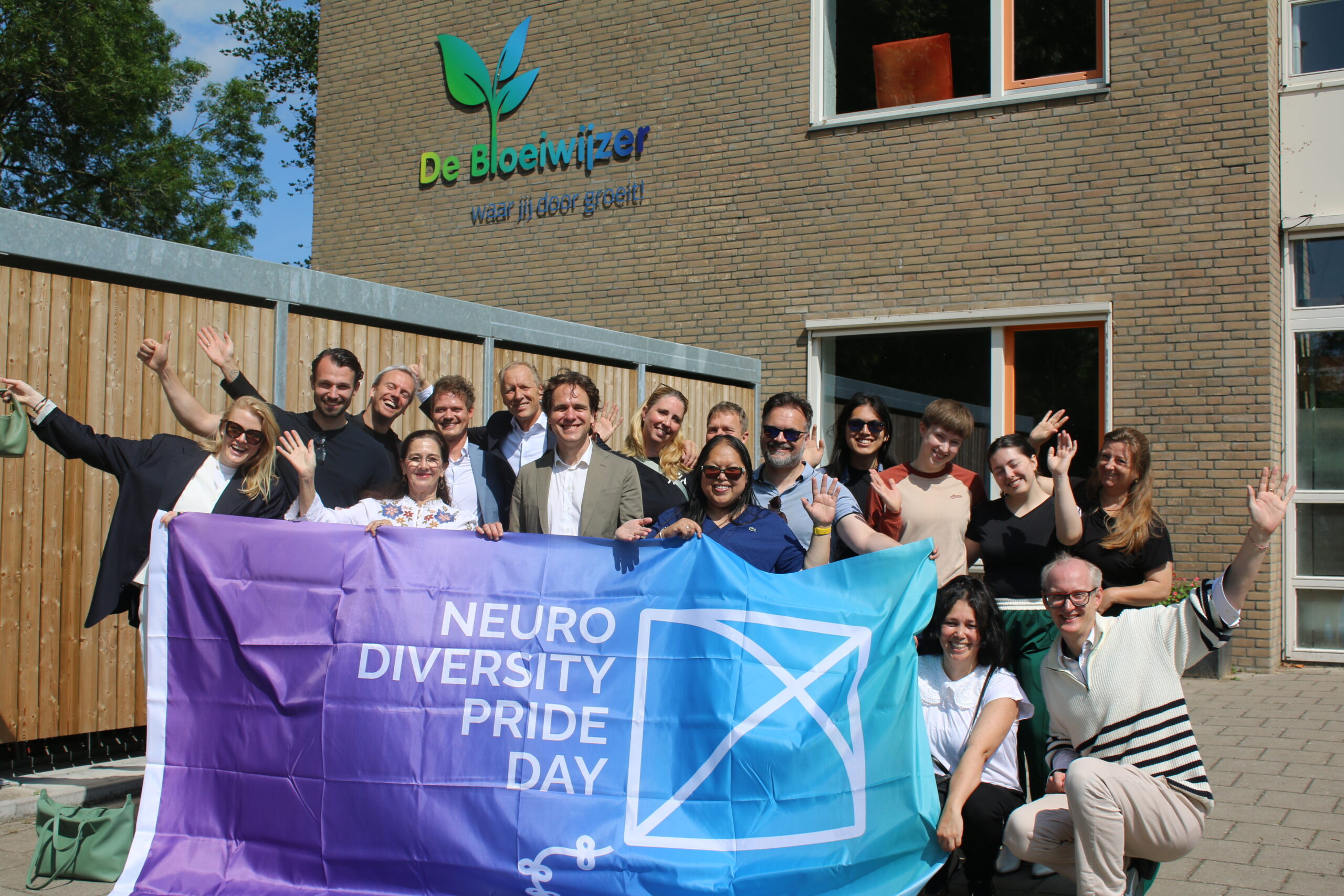
Already taking shape: The Wisdom Council, Executive Board, advisory guides, strategic scaling work and international coordination structures are helping the Foundation grow with care, responsibility and long-term resilience.
The Point on the Horizon: A financially steady, globally connected Foundation that can support neurodivergent kind for generations to come.
Mind-maps
swipe
Contact Us for More Information
Want to learn more about these campaigns, or have an idea how to contribute? Please get in touch!